



Descriptor
How ISOv8® by ContainerKing® supplies container-based and steel anti-vandal site buildings across the UK — aligning occupation duration, canteen requirements, service integration, operational intensity and long-term reliability.
Where This Page Sits in ISOv8®
Phase 3 — SEE focuses on understanding what well-considered shipping container conversions and steel anti-vandal buildings look like in practical commercial use across the UK.
P3.1.7 explores site infrastructure buildings supplied for construction, infrastructure, industrial, utilities and operational project environments across the UK. The purpose of this page is to help businesses understand how occupation levels, canteen requirements, operational pressure, environmental exposure and programme duration all influence how successful a site building becomes once daily use begins.
Rather than treating site cabins and temporary buildings as simple short-term conveniences, this page focuses on how these environments actually perform once staff occupation, repeated daily use, changing weather conditions and programme extension become operational reality.
1. What Steel Anti-Vandal Site Cabins & Temporary Buildings Are and How They Are Used in the UK
Site cabins, canteens, control rooms and temporary site buildings are used extensively across the UK, although they are often under-specified because they are initially viewed as short-term accommodation.
In practice, many of these buildings remain operational for substantially longer than originally expected.
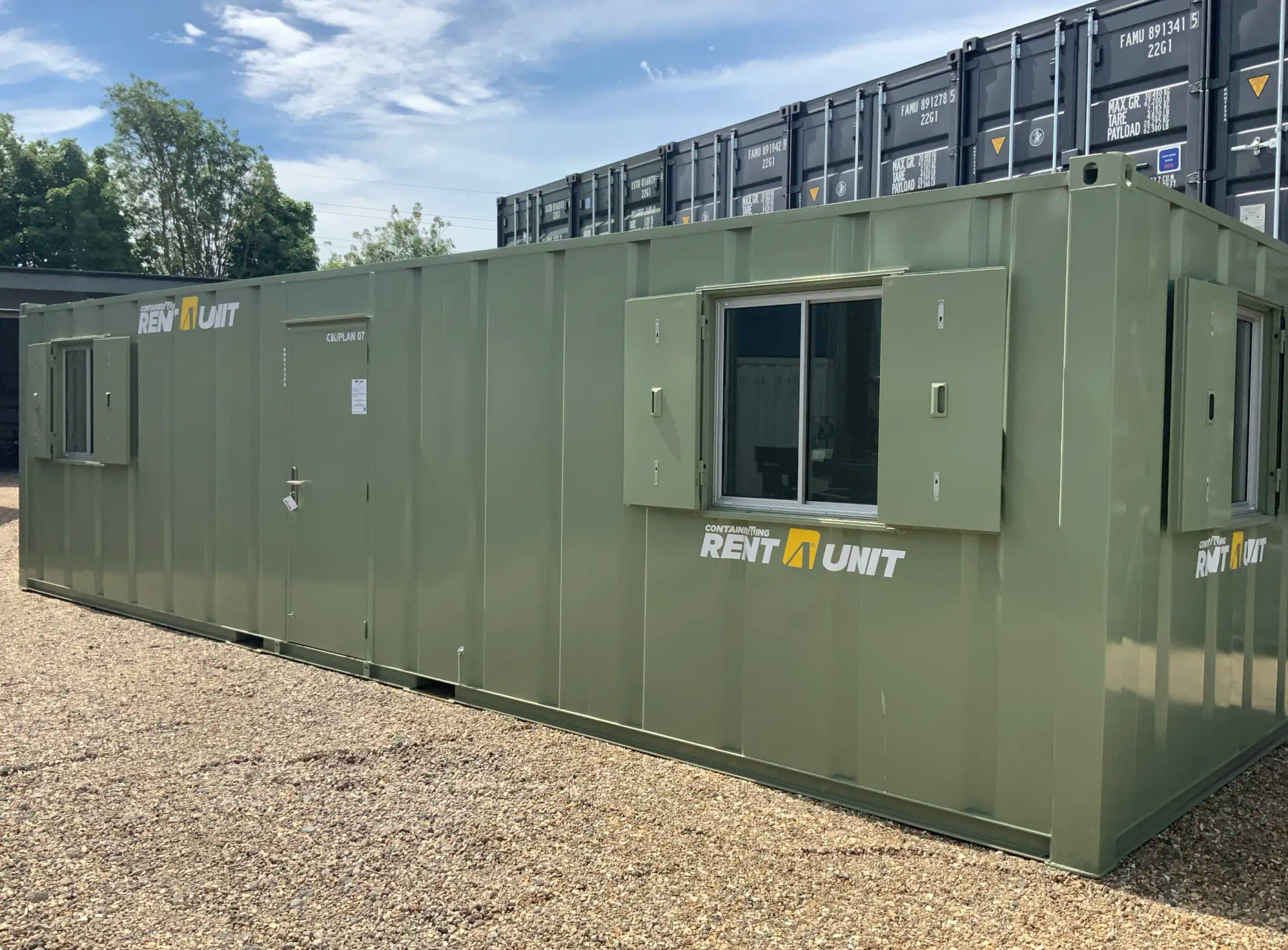
ISOv8® by ContainerKing® supplies container site offices, anti-vandal canteen buildings, control rooms, security cabins, monitoring stations, welfare accommodation and temporary-permanent site infrastructure buildings designed around genuine operational use rather than optimistic programme assumptions.
These are not casual temporary shelters. They are working environments supporting administration, supervision, welfare provision, canteen use, meetings, inductions, operational coordination and site control within demanding operational conditions.
Businesses searching for steel anti-vandal site office buildings for sale in the UK, anti-vandal canteen suppliers, portable site office buildings or temporary site infrastructure are usually trying to solve the same underlying issue: how to supply accommodation that remains reliable, practical, comfortable and commercially sensible once temporary occupation quietly becomes long-term operational reality.
Within this category, the defining issue is rarely short-term convenience.
It is long-term daily usability.
2. Who Uses Container Site Offices & Steel Anti-Vandal Site Buildings
Site infrastructure buildings supplied by ISOv8® are commonly used by construction contractors, civil engineering companies, utilities operators, infrastructure providers, industrial operators and project management teams requiring dependable operational accommodation on active sites.
These businesses generally require secure and durable environments capable of supporting daily occupation, administration, welfare provision, canteen use, meetings, monitoring functions and operational supervision, while remaining practical under changing site conditions and evolving project demands.
Across all of these sectors, the requirement is operational rather than theoretical. The building must function properly every day for the people relying on it and continue doing so once programme duration, staff numbers or operational pressure begin increasing beyond the original expectation.
3. What Site Buildings Must Support in Real Daily Use
In practical operational use, a site building must do substantially more than simply occupy space on a project.
The environment must support staff occupation, supervision, administration, meetings, inductions, welfare use, appliance operation, charging requirements, monitoring activity and secure day-to-day access under continual operational pressure.
That means the building must remain dependable through repeated door cycling, changing weather conditions, fluctuating user numbers, heavy daily occupation and ongoing environmental exposure.
A properly specified site building continues functioning effectively as projects evolve. An under-specified environment often becomes uncomfortable, maintenance-heavy, operationally frustrating and increasingly restrictive once real occupation begins.
This is particularly common where buildings originally intended for short-term use quietly become semi-permanent operational hubs.
4. How Site Buildings Are Configured for Occupation, Canteen Use & Operational Support
Site buildings are not defined purely by whether they are container-based or steel anti-vandal. Both are steel building platforms capable of delivering secure and practical operational accommodation.
What matters is how the building is configured around real occupancy patterns, user density, canteen requirements, operational intensity and likely programme duration.
Some projects require relatively straightforward office and welfare accommodation where moderate occupancy, relocation flexibility and rapid deployment remain important. Other operational environments gradually demand larger internal layouts, improved circulation, greater comfort, stronger service integration, increased canteen provision and better long-term usability because the building becomes central to day-to-day site operation rather than simply temporary accommodation.
The defining issue is therefore not the label attached to the building.
It is how effectively the environment continues functioning once real operational pressure begins.
5. How Site Buildings Perform Over Time in Real Site Conditions
Site infrastructure buildings are often one of the clearest examples of why realistic specification matters.
Buildings initially intended for relatively short occupation frequently remain operational for far longer than expected, and once this happens the quality of specification becomes increasingly visible in day-to-day use.
Container site offices and canteen buildings perform particularly well where deployment speed matters, occupation remains controlled, relocation flexibility is important and footprint discipline suits the operational layout of the site.
Larger steel anti-vandal site buildings become increasingly beneficial where user density rises, meetings become routine, canteen expectations increase, operational supervision expands or project duration extends substantially.
In practical use, this is where insulation quality, heating provision, lighting standards, electrical integration, hardware durability and overall layout planning begin influencing operational experience very clearly.
The longer the building remains occupied, the more important these factors become.
6. Key Features of Site Cabins, Canteens & Temporary Buildings for Business
The effectiveness of a site building is determined by how well its overall specification supports repeated occupation and operational reliability.
Secure anti-vandal construction remains important within exposed or high-traffic operational environments where buildings are subjected to repeated access, environmental exposure and continual day-to-day use.
Insulated internal environments improve year-round usability, while realistic heating, lighting, sockets, appliance provision and electrical integration are essential where buildings are genuinely occupied rather than simply present on site.
Modern operational environments also increasingly rely on communications infrastructure, charging systems, monitoring equipment and dependable data connectivity, meaning service integration now forms part of operational functionality rather than secondary specification.
Layout quality also matters substantially once meetings, welfare provision, inductions, supervision and canteen occupation become part of regular site activity.
Where rapid mobilisation remains important, deployment speed continues carrying operational value. Where occupation duration and user intensity increase, comfort, circulation and internal usability become progressively more commercially important.
7. What Determines Site Building Performance & Long-Term Usability
Within site infrastructure, performance is ultimately defined by occupation reality rather than initial assumptions.
The longer the building remains operational and the more heavily it is used, the more important overall specification quality becomes.
Insulation, condensation control, ventilation, heating provision, lighting quality, electrical infrastructure, circulation space, hardware durability and general day-to-day usability all influence how effectively the building continues functioning over time.
A building that only narrowly satisfies the original brief can quickly become restrictive once staff numbers increase, meetings become more frequent, canteen demand grows, project duration extends or the environment evolves into a genuine operational hub.
Container site offices and canteen buildings can perform extremely effectively where occupation levels remain realistic and the operational brief remains aligned to the structure.
Larger steel anti-vandal site buildings generally become the stronger solution where operational duration increases, user density rises, comfort standards matter more or the building becomes increasingly central to site management.
The key issue is not whether the building is described as temporary.
It is whether it still works properly once operational reality develops beyond the original assumption.
8. Common Mistakes When Buying Site Offices & Temporary Buildings in the UK
One of the most common commercial mistakes within this sector is underestimating extension risk.
Buildings expected to remain operational for a matter of months often stay in use substantially longer, and once this happens the consequences of under-specification begin appearing through reduced comfort, increased maintenance, operational frustration and avoidable disruption.
Common mistakes include designing purely for the shortest programme, underestimating occupancy levels, overlooking canteen standards, ignoring future service requirements, assuming compact layouts will always remain sufficient and purchasing purely around lowest initial cost rather than long-term operational usability.
An uncomfortable environment affects morale. A maintenance-heavy environment consumes management time. A poorly integrated environment creates operational friction every day.
The strongest long-term outcomes generally come from selecting site infrastructure that remains dependable once operational pressure inevitably increases beyond the original expectation.
9. How ISOv8® Supplies Site Infrastructure Buildings Across the UK
ISOv8® approaches site infrastructure with disciplined operational realism.
The process begins by understanding likely occupation duration, operational intensity, user density, welfare expectations, canteen requirements, environmental exposure and extension risk if programme timelines begin drifting.
From there, the building is configured around the likely pattern of real operational use rather than the most optimistic assumption.
This means container-based site accommodation is supplied where rapid deployment and moderate occupation genuinely suit the operational requirement, while larger steel anti-vandal buildings are supplied where longer occupation, heavier daily use, greater user density or improved comfort standards justify more substantial infrastructure.
Insulation, electrics, ventilation, heating and operational services are considered properly from the outset, and under-specification is challenged before it becomes a long-term operational problem.
The objective is not to supply the cheapest temporary structure possible.
The objective is to deliver dependable operational infrastructure that remains commercially sensible, comfortable and reliable once real site occupation begins.
10. Frequently Asked Questions — Site Offices & Canteen Buildings UK
What is the difference between a site cabin and a steel anti-vandal site building?
Steel anti-vandal site buildings are generally designed around harsher conditions, higher security expectations and longer operational occupation, often incorporating improved durability and stronger service integration.
Are container site offices suitable for long-term projects?
Yes, where occupation levels remain realistic and specification quality aligns correctly with operational demand. Where occupation increases substantially, larger steel anti-vandal buildings often provide stronger long-term usability.
What should be considered first: layout or services?
Both should be considered together because heating, lighting, ventilation, electrics and data infrastructure directly influence how effective the internal environment becomes in daily use.
Do canteen buildings require insulation?
Yes. For realistic year-round occupation and operational comfort, insulation and ventilation are essential rather than optional additions.
Why do temporary buildings often become problematic over time?
Problems usually develop when buildings originally specified for short-term use remain operational substantially longer without sufficient comfort, durability, environmental control or service integration.
Published: 12/09/2026
If you are considering commissioning a container office, workshop, storage unit or secure anti-vandal unit for site use and want clarity on structural suitability before specification is fixed, speak with ISOv8®. A short early discussion prevents disproportionate reinforcement and reactive redesign.
ISOv8® by ContainerKing® Limited Scunthorpe, North Lincolnshire
Tel: 01724 870000
Nationwide delivery across England, Scotland & Wales
Legal Disclaimer
The content provided in this document is for general information purposes only and is not intended to constitute legal, planning, building control, health and safety, or professional advice. Regulations and site-specific requirements vary widely across the UK. ISOv8® by ContainerKing® does not accept liability for actions taken, losses incurred, or decisions made based on the information provided. Always consult your local authority, planning department, building inspector, legal adviser, or relevant professional before starting any container project. Use of this document is entirely at your own risk. For more information, please see our Terms of Use.
Copyright Notice
© 2026 ISOv8® by ContainerKing®. All rights reserved. You are welcome to link to this page or share brief excerpts for commentary, review, or non-commercial purposes, provided proper credit is given to ISOv8® by ContainerKing®. No part of this document may be reproduced, distributed, or transmitted in full in any form or by any means without prior written permission from ISOv8® by ContainerKing®.