



Descriptor
How ISOv8® supplies container workshop conversions and steel anti-vandal workshop buildings for businesses across the UK — aligning workflow, structural performance, operational practicality, environmental conditions and long-term commercial reliability.
Where This Page Sits in ISOv8®
Phase 3 — SEE focuses on understanding what well-considered shipping container conversions and steel anti-vandal buildings look like in practical commercial use across the UK.
P3.1.1 explores bespoke workshop environments supplied for real operational business use, helping businesses assess how workshop layout, workflow, access, power demand, environmental conditions and long-term operational intensity influence the correct structural solution.
Rather than approaching workshop buildings purely as fabricated structures, this page focuses on how workshops actually perform in practical daily use once equipment, personnel movement, operational pressure and long-term commercial demand are introduced.
1. What The Product Is — Workshop Buildings for Business Use in the UK
Workshop buildings for business use are not generic structures or simple storage spaces. They are working environments used daily for fabrication, engineering, maintenance, repair, servicing, equipment preparation, storage and wider operational support, where building performance directly affects productivity.
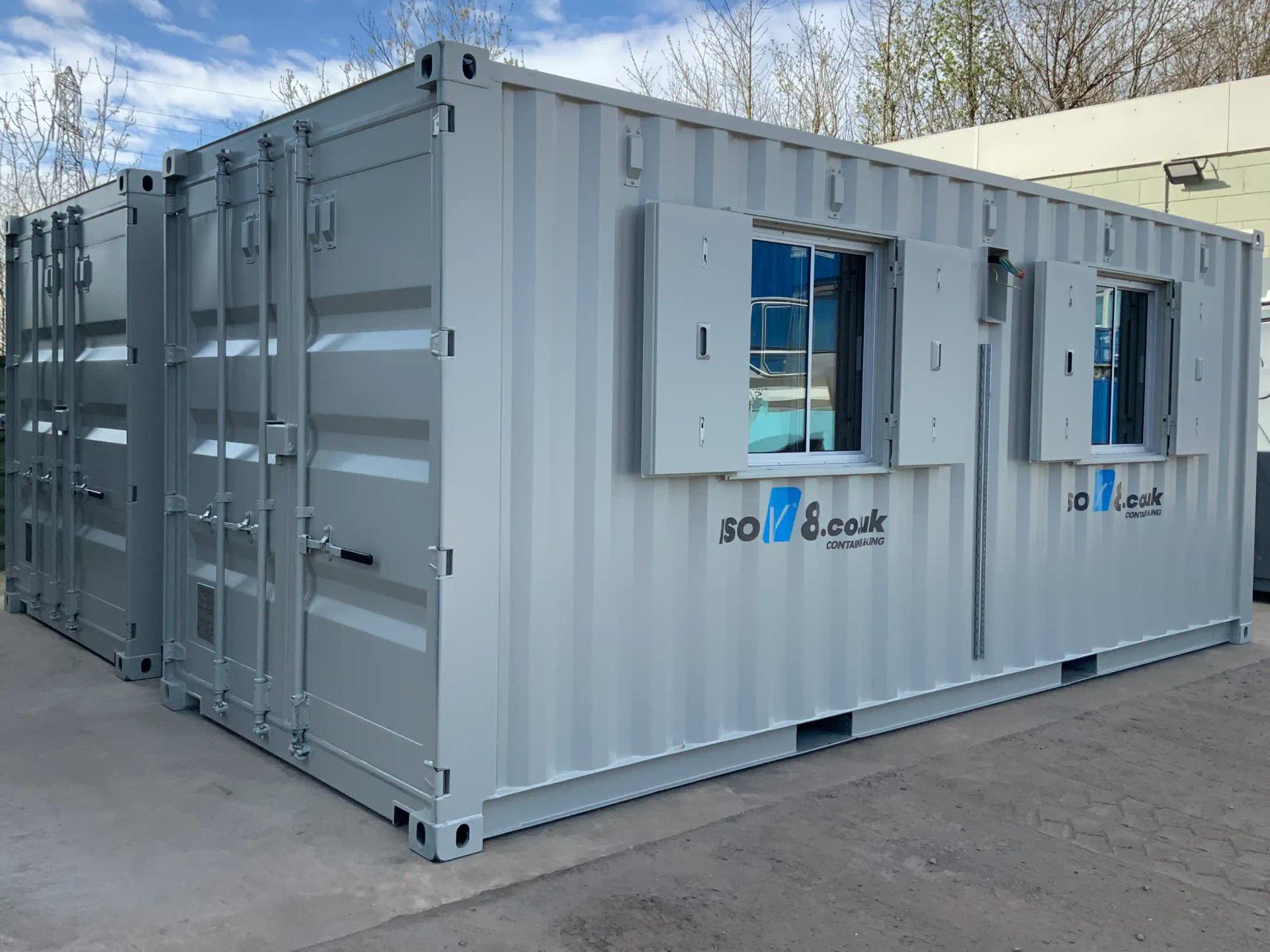
ISOv8® supplies workshop buildings across the UK using both container workshop conversions and steel anti-vandal workshop buildings. The correct solution is determined by how the space will be used in practice, not simply by footprint, availability or lowest initial purchase cost.
Customers searching for workshop buildings for sale in the UK, insulated workshop buildings, container workshop conversions, steel anti-vandal workshop buildings or bespoke portable workshops are usually trying to solve the same operational problem: creating a reliable, secure and commercially practical workspace that supports ongoing business use.
The requirement remains consistent.
The building must operate as a dependable working asset, not just provide enclosed space.
2. Who Uses Container Workshop Buildings & Steel Anti-Vandal Workshop Buildings in the UK
Workshop buildings supplied by ISOv8® are used across a wide range of UK industries where secure, practical and operationally reliable working environments are required.
Typical users include engineering and fabrication businesses, agricultural and ground maintenance operators, construction and utilities contractors, vehicle maintenance and repair businesses, property maintenance teams, infrastructure operators, industrial service providers and growing technical or trade-based businesses.
Across these sectors, the operational requirement remains remarkably consistent. The building must support daily business activity, provide safe and practical working conditions, secure valuable tools and equipment, and continue performing reliably as operational demand increases over time.
In many cases, the workshop quickly becomes integrated into wider operational workflow rather than remaining a temporary or secondary facility. This places greater importance on correct specification from the outset, particularly where future growth, increased equipment use, additional personnel or evolving operational requirements are expected.
3. What Workshop Buildings Must Support in Real Daily Operation
A workshop building is ultimately defined by how effectively it functions in practical use rather than by structure alone.
In real operational environments, the space must support safe movement, efficient workflow, correct equipment positioning, reliable electrical supply, secure storage and practical day-to-day usability. Access arrangements must allow movement of materials, tools, equipment and, where required, vehicles or plant machinery without creating operational restriction.
Ventilation, insulation, extraction systems and internal environmental behaviour also influence how usable the workshop remains throughout the year. A workshop that performs properly in summer but becomes uncomfortable, damp, poorly ventilated or difficult to work in during colder months has not been specified correctly for long-term commercial use.
Where these elements align correctly, the workshop supports productivity immediately and continues to do so as demand increases. Where they do not align, restrictions often appear quickly through inefficient layout, restricted movement, unsuitable internal conditions, limited access or poor long-term usability.
These are rarely structural failures.
More commonly, they are operational limitations created through incorrect specification or poor alignment between the building and its intended use.
4. Container Workshop Buildings vs Steel Anti-Vandal Workshop Buildings — Key Differences
Workshop buildings for business use in the UK are typically supplied using either container-based structures or steel anti-vandal buildings. Both can provide effective commercial workshop environments, but they are suited to different operational priorities.
Container workshop buildings provide a compact, secure and relocatable solution with a strong perimeter structure. They are particularly effective where workflows are predictable, equipment layout is controlled and available space can be used efficiently within ISO container dimensions.
Steel anti-vandal workshop buildings are fabricated around more specific operational requirements and generally provide greater internal width, improved spatial flexibility, enhanced layout practicality and more comfortable occupied working environments.
They are typically more suitable where operational intensity increases, multiple users occupy the building, larger equipment is introduced, workflow becomes more complex or internal layout flexibility becomes increasingly important.
The correct choice is not determined by familiarity or preference. It is determined by how effectively the structure supports the intended use over time.
Where operational demand, occupancy, workflow complexity or equipment requirements increase, the limitations of container geometry can become increasingly apparent, making steel anti-vandal workshop buildings the more commercially appropriate long-term solution.
5. How Workshop Buildings Perform Over Time in Real Use
Workshop buildings are not truly tested during installation.
They are tested through daily operational use.
Over time, buildings are subjected to repeated access, continuous equipment use, environmental variation, operational wear, increasing workflow pressure and changing commercial demand. These conditions quickly reveal whether the original specification aligned properly with practical operational use.
Container workshop buildings generally perform extremely effectively where operational demand remains controlled and spatial limitations remain manageable. Steel anti-vandal workshop buildings become increasingly advantageous where usage intensifies, layouts evolve, personnel numbers increase or flexibility becomes commercially important.
In practical use, the difference between the two platforms becomes visible through how effectively the building supports workflow, movement, equipment positioning, operational comfort and future scalability.
When a workshop has been correctly specified, it should not feel like a compromise each time the business grows, adds equipment or increases workload. It should remain a practical working asset capable of supporting the operation properly over time.
6. Key Features of Workshop Buildings for Commercial Use
The effectiveness of a workshop building is determined by how its features support practical long-term operational use.
Security remains essential where valuable tools, equipment, stock or operational assets are stored on site. Access arrangements must support workflow efficiently, allowing movement of materials and equipment without creating bottlenecks or daily frustration.
Electrical systems must support both current operational demand and future expansion, particularly where higher power loads, machinery operation, welding equipment, compressors, extraction systems or three-phase electrical supply may be required.
Internal insulation and lining systems influence year-round usability, thermal behaviour, condensation control and occupied working comfort. Flooring must suit anticipated loading requirements, while ventilation and extraction systems contribute significantly toward safe and practical operating conditions.
Where long-term operational growth is expected, future adaptability also becomes an important consideration. A workshop building should not only answer today’s requirement; it should be capable of supporting the direction of the business as that requirement develops.
7. What Determines Workshop Building Performance and Long-Term Usability
Workshop building performance is determined primarily by how accurately specification aligns with practical operational demand.
Access design must reflect how equipment, stock, materials and machinery move throughout the space during real use. Floor loading should account for operational point loads rather than relying purely on generic assumptions. Electrical infrastructure must support both peak demand and future scalability.
Ventilation and extraction systems influence safety, environmental stability, usability and operational comfort, while thermal behaviour affects condensation risk, long-term durability and occupied working conditions.
Container workshop buildings perform highly efficiently within defined operational and spatial limits. Steel anti-vandal workshop buildings extend those limits where operational complexity, occupancy or flexibility requirements increase.
Performance is therefore a result of correct alignment between operational demand, specification and structural suitability, rather than from the structure alone.
8. Common Mistakes When Buying Workshop Buildings for Business in the UK
Workshop buildings are frequently mis-specified when decisions are made without fully assessing how the space will function in practical use.
Common mistakes include focusing on external footprint rather than workflow, underestimating access requirements, overlooking future operational growth, selecting purely on lowest initial purchase cost, underestimating electrical demand or failing to properly assess environmental performance requirements.
These decisions often lead to restricted usability, inefficient workflow, reduced productivity, retrofit expenditure, premature modification costs and reduced long-term commercial value.
Where specification aligns correctly with operational demand, the building continues supporting the business effectively as requirements evolve over time.
Where it does not, the limitations usually become obvious only after the building is in regular use — when equipment has been installed, staff are working inside it, access is being tested daily and the business has already committed capital to the wrong solution.
That is why workshop buildings should be considered in terms of long-term operational suitability, not just initial appearance or purchase price.
9. How ISOv8® Supplies Workshop Buildings Across the UK
ISOv8® supplies workshop buildings based on how they are expected to perform in practical operational use.
Each project begins with the operational requirement. The work is defined first, followed by how the space will be used, the level of operational demand, access requirements, equipment use, power demand, environmental conditions and how that demand may increase over time.
Only then is the correct structural platform selected.
This approach helps ensure container workshop buildings are used where they perform effectively, and steel anti-vandal workshop buildings are supplied where greater operational flexibility, space or long-term usability becomes commercially important.
The objective is not simply to supply a workshop building.
The objective is to supply a workshop environment capable of continuing to perform properly once operational demand increases over time.
10. Frequently Asked Questions — Workshop Buildings UK
What is the best workshop building for a small business in the UK?
For smaller operations with controlled workflow and predictable equipment requirements, a container workshop conversion can provide a highly secure and commercially efficient solution when correctly specified.
Can container workshop buildings support three-phase power?
Yes. Electrical systems can be designed to accommodate higher operational demand including three-phase supply, machinery operation, compressors, extraction systems and specialist equipment requirements.
When should a steel anti-vandal workshop building be used instead of a container workshop?
Steel anti-vandal workshop buildings generally become more suitable where internal width, layout flexibility, equipment size, occupancy levels or long-term operational intensity exceed the practical limitations of ISO container geometry.
Do workshop buildings require planning permission in the UK?
Planning requirements vary depending on location, scale, operational use and site conditions. Early consultation is always recommended before committing to a building specification.
Are insulated workshop buildings worthwhile for year-round commercial use?
Yes. Proper insulation, ventilation and internal lining systems help improve occupied comfort, condensation control, environmental stability and long-term operational usability.
11. Visit ISOv8® Workshop Buildings — Scunthorpe, North Lincolnshire
ISOv8® operates from Scunthorpe, North Lincolnshire, supplying container workshop conversions and steel anti-vandal workshop buildings throughout England, Scotland and Wales.
Representative workshop examples can be viewed on site, allowing businesses to assess layout practicality, internal configuration, access arrangements, internal finishes and overall build quality before specification and purchasing decisions are made.
This provides a clearer understanding of how different workshop environments perform in practical operational form and helps customers make more informed decisions before committing to a finished building.
Published: 12/09/2026
If you are considering commissioning a container office, workshop, storage unit or secure anti-vandal unit for site use and want clarity on structural suitability before specification is fixed, speak with ISOv8®. A short early discussion prevents disproportionate reinforcement and reactive redesign.
ISOv8® by ContainerKing® Limited Scunthorpe, North Lincolnshire
Tel: 01724 870000
Nationwide delivery across England, Scotland & Wales
Legal Disclaimer
The content provided in this document is for general information purposes only and is not intended to constitute legal, planning, building control, health and safety, or professional advice. Regulations and site-specific requirements vary widely across the UK. ISOv8® by ContainerKing® does not accept liability for actions taken, losses incurred, or decisions made based on the information provided. Always consult your local authority, planning department, building inspector, legal adviser, or relevant professional before starting any container project. Use of this document is entirely at your own risk. For more information, please see our Terms of Use.
Copyright Notice
© 2026 ISOv8® by ContainerKing®. All rights reserved. You are welcome to link to this page or share brief excerpts for commentary, review, or non-commercial purposes, provided proper credit is given to ISOv8® by ContainerKing®. No part of this document may be reproduced, distributed, or transmitted in full in any form or by any means without prior written permission from ISOv8® by ContainerKing®.